

Withdrawal Strategies
Is the 4% Rule Safe in 2027? What New Research Says
Morningstar's 2026 research puts a base-case safe withdrawal rate near 3.9%. See what that means in dollars, what changes your own rate and how to apply the 4% rule in 2027.
Find out how much you need saved today to coast to your FIRE number — no more contributions needed.
Updated for 2027
Enter your details to see your Coast FIRE number, status, and growth projection.
Based on 4% SWR rule. Educational use only.
Coast FIRE is a checkpoint on the way to financial independence. Once your invested savings reach a certain size, compound growth can take them to your full retirement target without another contribution. From that point you only need to earn enough to pay for today's life, which opens up lower-stress jobs, part-time work, career changes or a sabbatical.
The calculator above shows two numbers: your FIRE number (the portfolio that funds retirement) and your Coast FIRE number (what you need invested now). Compare the second with your balance to see whether you have already coasted, or how large the gap is.
FIRE number = annual spending × 25 (a 4% withdrawal rate)
Coast FIRE number = FIRE number ÷ (1 + r)n, where r is the annual return and n is years until retirement.
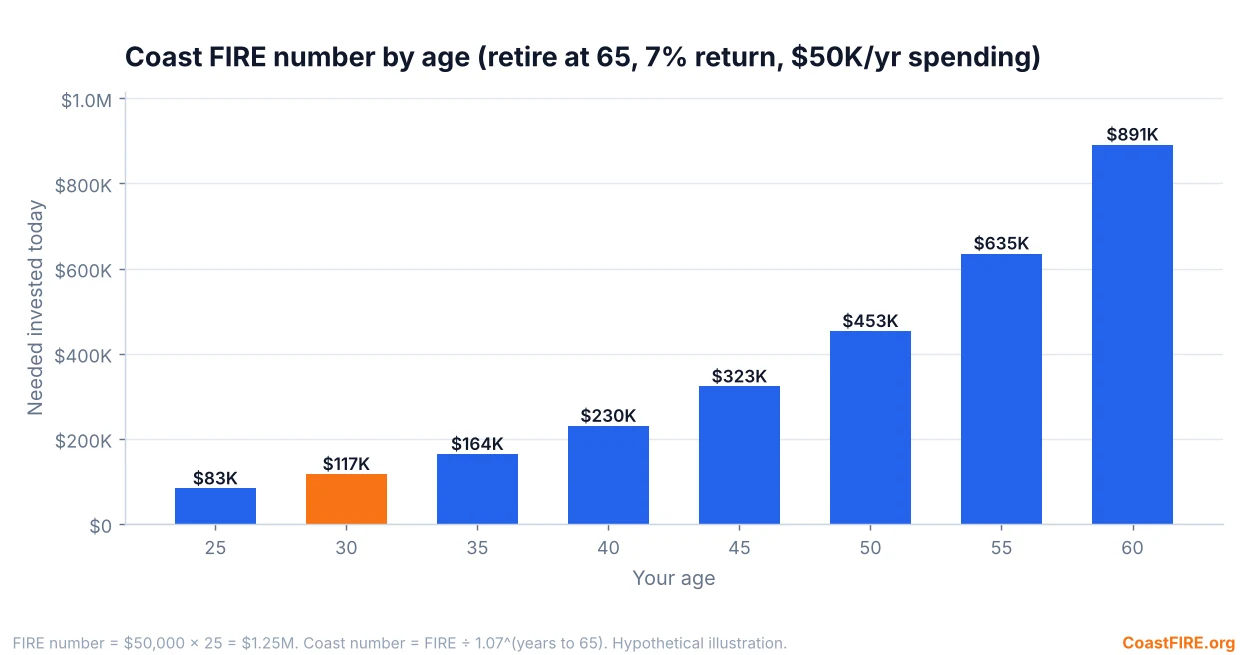
Hypothetical example: you want to spend $50,000 a year in retirement, so your FIRE number is $1,250,000. You are 30, plan to retire at 65, and assume a 7% return. That is 35 years of growth: $1,250,000 ÷ 1.0735 = $117,079. If you already have that much invested, growth alone is projected to reach $1,250,000 by 65. You can check it in a spreadsheet with =PV(0.07, 35, 0, -1250000).
Time is the biggest lever. The table uses the same example ($50,000 spending, retire at 65, 7% return):
| Your age | Years to 65 | Coast FIRE number | As % of FIRE number |
|---|---|---|---|
| 25 | 40 | $83,475 | 6.7% |
| 30 | 35 | $117,079 | 9.4% |
| 35 | 30 | $164,209 | 13.1% |
| 40 | 25 | $230,311 | 18.4% |
| 45 | 20 | $323,024 | 25.8% |
| 50 | 15 | $453,058 | 36.2% |
| 55 | 10 | $635,437 | 50.8% |
Your spending target matters as much as your age. Each extra $10,000 of yearly spending adds $250,000 to your FIRE number (at 4%):
| Retirement spending / yr | FIRE number | Age 25 | Age 30 | Age 35 | Age 40 |
|---|---|---|---|---|---|
| $30,000 | $750,000 | $50,085 | $70,247 | $98,525 | $138,187 |
| $40,000 | $1,000,000 | $66,780 | $93,663 | $131,367 | $184,249 |
| $50,000 | $1,250,000 | $83,475 | $117,079 | $164,209 | $230,311 |
| $60,000 | $1,500,000 | $100,171 | $140,494 | $197,051 | $276,374 |
| $80,000 | $2,000,000 | $133,561 | $187,326 | $262,734 | $368,498 |
Retire at 65, 7% return, 4% withdrawal rate, no further contributions.
| Type | What it means |
|---|---|
| Coast FIRE | Your portfolio will grow to your retirement target on its own. You still earn enough to cover current expenses. |
| Barista FIRE | Your portfolio covers part of your spending now; part-time work covers the rest (and sometimes benefits). |
| Lean FIRE | Full independence on a small budget. There is no official cut-off; the community often means a low-spending lifestyle. |
| Fat FIRE | Full independence with a generous budget. Needs a much larger portfolio, so it takes longer. |
Seven percent is a nominal figure. If inflation averages about 2.5%, the real return is closer to 4.4%. Run the same example with 4.5%: the age-30 Coast FIRE number rises from $117,079 to $267,818 in today's money. Testing both is the simplest way to see how sensitive your plan is.
Coast FIRE funds retirement, not today. If your income falls below your current expenses, you will start drawing down the portfolio and the number no longer holds.
The 25× rule uses gross spending. Taxes on withdrawals, and health insurance before public coverage starts (for example Medicare at 65 in the US), can add real cost. Add them to your spending estimate.
Retirement accounts often have age rules and penalties. If your plan involves leaving work before the normal access age, check the rules for your account type, such as the 401(k) and IRA rules on the IRS pages linked below.
Returns arrive unevenly. A bad first decade can hurt more than the same average spread evenly. Many people aim for 10% to 20% above their calculated number before they slow down.
The formula does not change by country, but the accounts you use do. Use the currency selector at the top to see results in your own currency.
| Country | Common tax-advantaged accounts | Note |
|---|---|---|
| United States | 401(k), IRA / Roth IRA, HSA | 2026 limits: $24,500 for a 401(k) and $7,500 for an IRA, per the IRS. 2027 limits are announced by the IRS later. |
| India | EPF, NPS, PPF, equity mutual fund SIPs | Use INR and a return that fits your asset mix. Lock-in periods differ by product. |
| United Kingdom | Workplace pension, SIPP, Stocks & Shares ISA | The ISA allowance is £20,000 in the 2026 to 2027 tax year (GOV.UK). |
| Canada | RRSP, TFSA | Contribution room depends on your income history and is shown in your CRA account. |
| Australia | Superannuation | Super is generally preserved until you reach preservation age. |
It is the amount you need invested today so that, with no further contributions, growth alone carries it to your full FIRE number by your target retirement age. It equals your FIRE number divided by (1 + return)years.
Regular FIRE means you can stop working because your portfolio funds your spending now. Coast FIRE means your retirement is funded by growth, but you still earn enough to pay your current bills until you reach retirement age.
The calculator uses the nominal return you enter and does not adjust for inflation. A common planning approach is to enter a real (after-inflation) return, for example about 4% to 5%, and to keep spending in today's money. Using 7% nominal while also ignoring inflation overstates how much your money will really buy.
No. The calculator assumes your portfolio funds all spending. If you expect Social Security, a pension or rental income, subtract the expected annual amount from your retirement spending first, then enter the remainder. You can estimate benefits at ssa.gov.
Mathematically yes, if returns match your assumption. In practice returns vary, so many people keep a margin of safety (for example 10% to 20% above the number) or keep saving a small amount. Treat the result as a milestone, not a guarantee.
The math is identical; only the accounts, taxes and return assumptions change. Use the currency selector at the top of the page and enter a return that fits your market and your account types. See the country table above for the main tax-advantaged accounts.
With Coast FIRE you need only enough income to cover current living costs. With Barista FIRE you have a portfolio that covers part of your retirement spending now and a part-time job covers the rest, often partly for benefits such as health insurance.
Educational content only, not personal financial advice. Examples are hypothetical and use constant returns; real markets are uneven. See our methodology, editorial policy and disclaimer.
Morningstar's 2026 research puts a base-case safe withdrawal rate near 3.9%. See what that means in dollars, what changes your own rate and how to apply the 4% rule in 2027.
How a SIP calculator works, with rupee examples for ₹5,000, ₹10,000 and ₹25,000 a month over 10, 15 and 20 years, plus inflation and what the numbers do not show.