


The 4% rule says you can withdraw 4% of your portfolio in the first year of retirement, raise that amount with inflation each year, and expect the money to last about 30 years. It is the basis of the "multiply spending by 25" shortcut. As we head into 2027, is it still a reasonable starting point? Current research says yes, with some important conditions.
Where the 4% rule came from
The rule comes from US historical research: William Bengen's 1994 study, followed by the 1998 "Trinity Study". They tested stock and bond portfolios across many 30-year periods and found that withdrawing about 4% of the starting balance, adjusted for inflation each year, survived the historical periods they examined. It is a historical result, not a guarantee about the future.
What Morningstar's 2026 research says
Morningstar's retirement researchers publish a forward-looking safe withdrawal rate each year. Their 2026 edition gives a base-case starting rate of 3.9% under these assumptions:
- A 30-year retirement.
- A 90% probability that the money lasts.
- Fixed withdrawals that rise with inflation.
- A portfolio with 30% to 50% in stocks.
- Forward-looking return and inflation estimates (inflation about 2.46%).
- No other income such as Social Security counted.
The same research finds that retirees who are willing to adjust spending can start higher, near 6%, because flexible strategies handle bad markets better than fixed ones. In other words, 3.9% and 4% are close, and the bigger lever is how flexible you are.
What the difference means in dollars
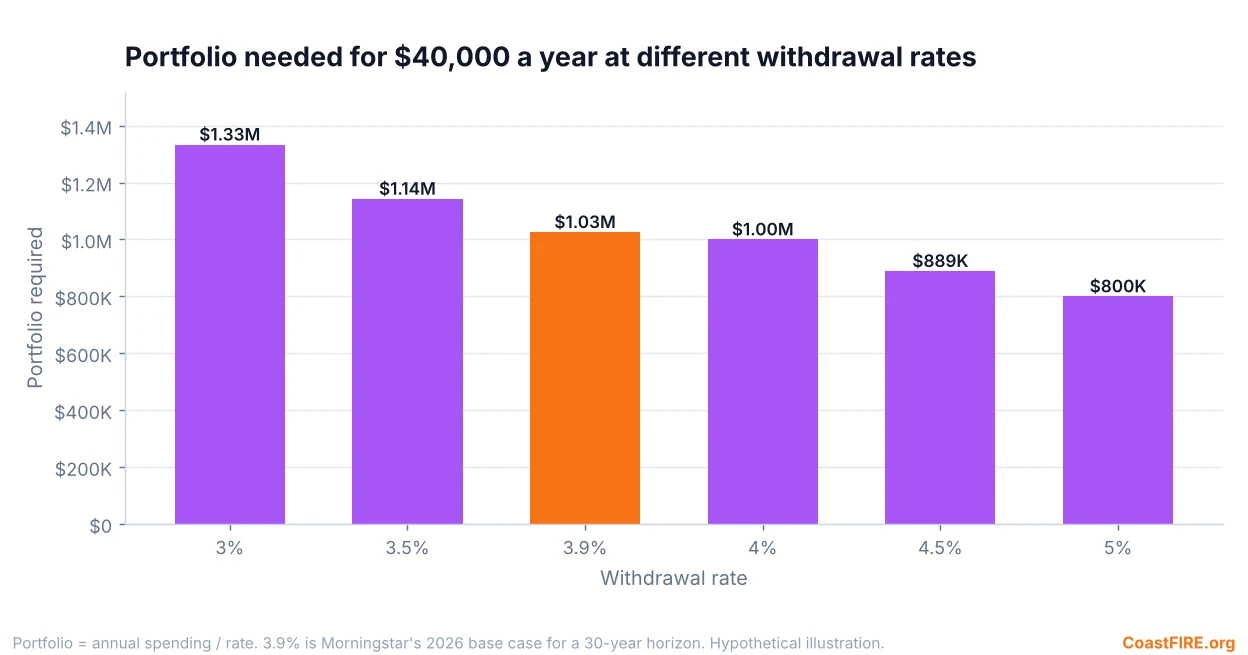
| Withdrawal rate | Income from $1,000,000 | Portfolio needed for $40,000/yr |
|---|---|---|
| 3.0% | $30,000 | $1,333,333 |
| 3.5% | $35,000 | $1,142,857 |
| 3.9% | $39,000 | $1,025,641 |
| 4.0% | $40,000 | $1,000,000 |
| 4.5% | $45,000 | $888,889 |
On a $1,000,000 portfolio, the gap between 3.9% and 4% is $1,000 a year. The gap between 3.5% and 4.5% is $10,000 a year. The rate matters, but it is not a cliff.
What changes your own safe rate
| Factor | Effect on the safe rate |
|---|---|
| Longer retirement (40 to 50 years) | Pushes the safe rate down. Many early retirees test 3% to 3.5%. |
| Spending flexibility | Raises it. You can cut after bad years and spend more after good ones. |
| Other income (Social Security, pension) | Lowers the portfolio's burden, so the portfolio needs to fund less. |
| Stock allocation | Too low or too high can both hurt. Morningstar's base case uses 30% to 50% stocks. |
| Country | The original studies used US data. Other markets have had different histories. |
How to use the 4% rule sensibly in 2027
- Treat 4% as a starting point. Test 3.5% and 3% in the SWR calculator to see the extra portfolio each requires.
- Subtract guaranteed income first. Use the SSA estimator if you are in the US, then size the portfolio for the remainder.
- Decide your flex rule in advance. For example, trim spending after a year of large losses. Having a plan makes it easier to follow.
- Keep a cash buffer for one to two years of spending so you are not forced to sell in a downturn.
- Re-test once a year with your real balance and spending.
If you are planning to retire early, read our retirement explainer on how much you need on $2,000 a month, which compares 3%, 3.5% and 4%. For a UK perspective, Morningstar also publishes an analysis for UK retirees.
Common misunderstandings about the 4% rule
- "I withdraw 4% of my balance every year." No. You withdraw 4% of the starting balance in year one, then raise that dollar amount with inflation. Withdrawing 4% of the current balance each year is a different strategy.
- "It guarantees success." No. It describes what worked historically. Morningstar's own base case assumes a 90% chance of success, not 100%.
- "It applies to any portfolio." No. The research assumed diversified stock and bond portfolios.
- "I must follow it rigidly." No. Most real retirees adjust spending, and research shows flexibility improves outcomes.
A simple flexibility rule, illustrated
Suppose you retire with $1,000,000 and plan to withdraw $40,000 in year one (4%). A simple guardrail might be: if the portfolio falls more than 15% below its starting value, skip the inflation raise that year, or trim spending by 10%. In a year when you apply the trim, spending would drop from $40,000 to $36,000, a saving of $4,000. The point is not the exact rule but having one. The formal versions, such as the Guyton-Klinger guardrails, use similar logic with tested thresholds.
If you cannot live with a 10% cut, you probably want a lower starting rate or a guaranteed-income floor from Social Security, a pension or an annuity.
Quick decision guide
| If this describes you | Consider |
|---|---|
| Retiring at a traditional age, spending is mostly flexible | 4%, or Morningstar's 3.9% base case, with a flex rule |
| Retiring early, a 40 to 50 year horizon | 3% to 3.5%, plus some part-time income if possible |
| Spending is mostly fixed and essential | A lower rate, or cover essentials with guaranteed income |
| Retiring outside the US | Test several rates and be more conservative |