


A SIP, or Systematic Investment Plan, is a way to invest a fixed amount in a mutual fund every month. It is popular in India because it turns investing into a habit and starts with small amounts. This guide explains how a SIP calculator works, shows rupee examples in lakh and crore, and points out what the numbers do not tell you.
What a SIP calculator actually computes
A SIP calculator estimates the future value of regular monthly investments at an assumed return. The formula for monthly compounding with contributions at the end of each month is:
Future value = SIP × [((1 + i)n − 1) ÷ i], where i is the monthly return (annual return ÷ 12) and n is the number of months.
Some online calculators assume you invest at the start of each month, which gives a slightly higher number (multiplied by 1 + i). Our investment calculator uses end-of-month contributions, so compare like with like.
How much does a monthly SIP grow to?
The table assumes a 10% annual return. This is an assumption for illustration, not a forecast; market-linked returns vary and can be negative over short periods.
| Monthly SIP | 10 years | 15 years | 20 years |
|---|---|---|---|
| ₹5,000 | ₹10.24 lakh | ₹20.72 lakh | ₹37.97 lakh |
| ₹10,000 | ₹20.48 lakh | ₹41.45 lakh | ₹75.94 lakh |
| ₹25,000 | ₹51.21 lakh | ₹1.04 crore | ₹1.90 crore |
10% annual return, monthly compounding, contributions at month end, before tax and expenses.
Example: a ₹10,000 SIP for 15 years at 12% puts in ₹18.00 lakh and is projected to grow to ₹49.96 lakh. About ₹31.96 lakh of that is growth. A 12% rate is a high assumption; test lower ones too.
Why the return assumption matters
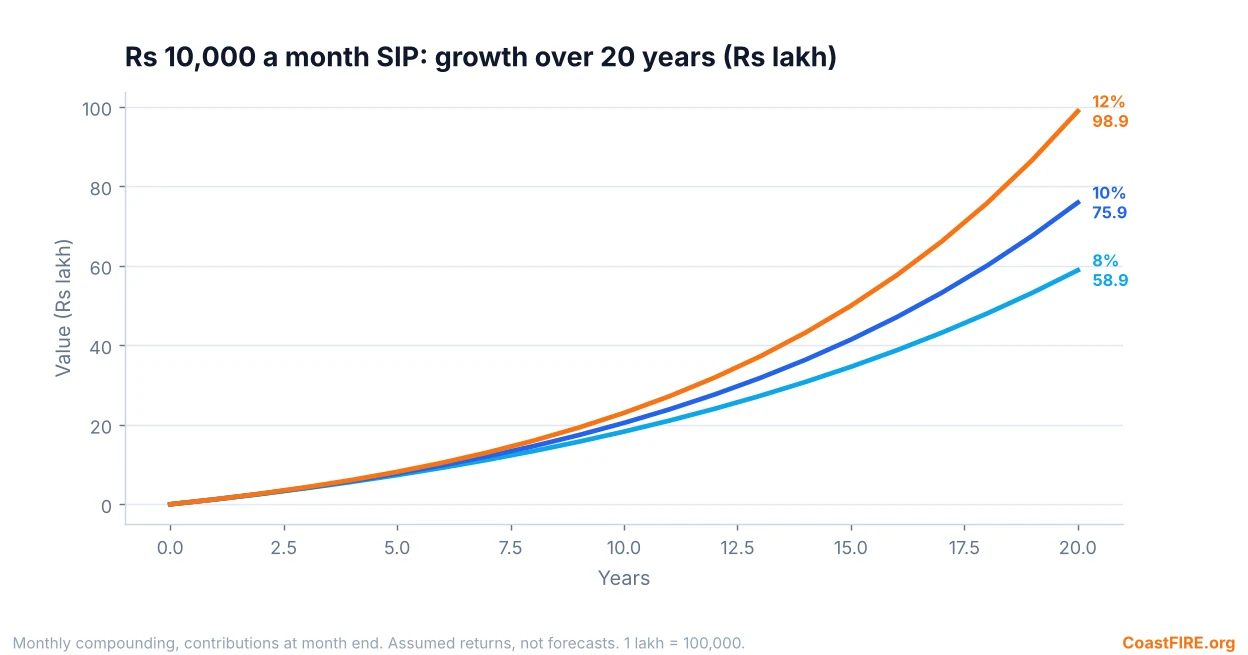
The gap between 8% and 12% after 20 years is large, which is why a single number from a calculator should never be treated as a promise. Use a range and plan around the lower end.
Adjust for inflation
A big number in the future buys less than the same number today. At 6% inflation, ₹1.00 crore in 20 years has the purchasing power of about ₹31.18 lakh in today's money. To see results in today's terms, enter a real return (return minus inflation) instead of the nominal one. We explain the method in Real vs Nominal Returns.
How to use the calculator for a SIP
- Open the investment calculator and choose INR in the currency selector at the top of the page.
- Enter your starting amount (use 0 if you are starting fresh) and your monthly SIP in rupees.
- Enter an expected annual return and the number of years.
- Read the final value and the split between what you invested and what growth added.
- Repeat with two or three different returns to see the range.
What a SIP calculator cannot tell you
- Actual returns. Mutual fund returns are not guaranteed. Read the scheme documents and the risk label before investing.
- Costs. Expense ratios reduce your return. Enter a net return, not a headline one.
- Taxes. Tax rules on mutual fund gains change over time. Check the current rules with the Income Tax Department or a qualified professional.
- Your goal. The right SIP depends on what you are saving for and when you need the money. A goal-based approach works better than picking a number at random.
For official investor education, see AMFI and SEBI. Our India guides cover more topics for Indian savers.
How much SIP do you need for a goal?
You can also work backwards: choose a target and find the monthly SIP. The table shows the SIP needed to reach ₹1.00 crore (₹1 crore) under two assumed returns:
| Time | At 10% return | At 12% return |
|---|---|---|
| 10 years | ₹48,817 / month | ₹43,471 / month |
| 15 years | ₹24,127 / month | ₹20,017 / month |
| 20 years | ₹13,169 / month | ₹10,109 / month |
| 25 years | ₹7,537 / month | ₹5,322 / month |
Time is the strongest lever. Notice how much smaller the monthly amount becomes when you start earlier, even with a lower return.
Step-up SIP: raising your SIP every year
Most people earn more over time, so a flat SIP can become a smaller share of income. A "step-up" SIP raises the monthly amount each year. Starting at ₹10,000 a month with a 10% assumed return over 20 years:
| SIP style | Total invested | Value after 20 years |
|---|---|---|
| Flat ₹10,000 | ₹24.00 lakh | ₹75.94 lakh |
| Step-up 10% a year | ₹68.73 lakh | ₹1.60 crore |
The step-up plan invests more in total, so the higher result is not "free". But if your income rises, increasing your SIP by a modest percentage each year is a practical way to keep up. The basic investment calculator on this site uses a flat amount; use the flat result as the conservative case.