Most Coast FIRE examples online use a 7% return and a simple formula. The result looks encouraging, and it is often too low. The reason is a mix-up between nominal and real returns, and it can cut your Coast FIRE number by more than half.
Nominal vs real returns in one minute
A nominal return is what your investments earn before inflation. A real return is what is left after prices rise. If your portfolio grows 7% and inflation is 2.5%, your purchasing power grows by about 4.39%, not 7%. The exact link is: real = (1 + nominal) ÷ (1 + inflation) − 1.
For reference, Morningstar's 2026 retirement-income research uses an expected inflation rate of about 2.46%, so 2.5% is a reasonable planning figure. Your own country and period may differ.
The mistake: nominal growth, today's-dollar target
Say you want to spend $50,000 a year in retirement in today's money. At a 4% withdrawal rate your FIRE number is $1,250,000. You are 30, retire at 65, and assume 7% growth. The common shortcut gives:
$1,250,000 ÷ 1.0735 = $117,079
The problem: the $1,250,000 target is in today's dollars, but the 7% growth is in future dollars. In 35 years, prices will be higher, so you need more than $1,250,000 of future dollars to buy the same life. The numbers are in different units.
Two correct ways to do it
Method 1: use a real return with today's dollars
Keep the target in today's dollars and grow money at the real return (4.39%): $1,250,000 ÷ 1.043935 = $277,852.
Method 2: inflate the target and use the nominal return
Inflate the target: $1,250,000 × 1.02535 = $2,966,506. Then discount at 7%: $2,966,506 ÷ 1.0735 = $277,852.
Both methods give the same answer, about $277,852. The shortcut's $117,079 is less than half of that. This is the gap that makes people think they have coasted when they have not.
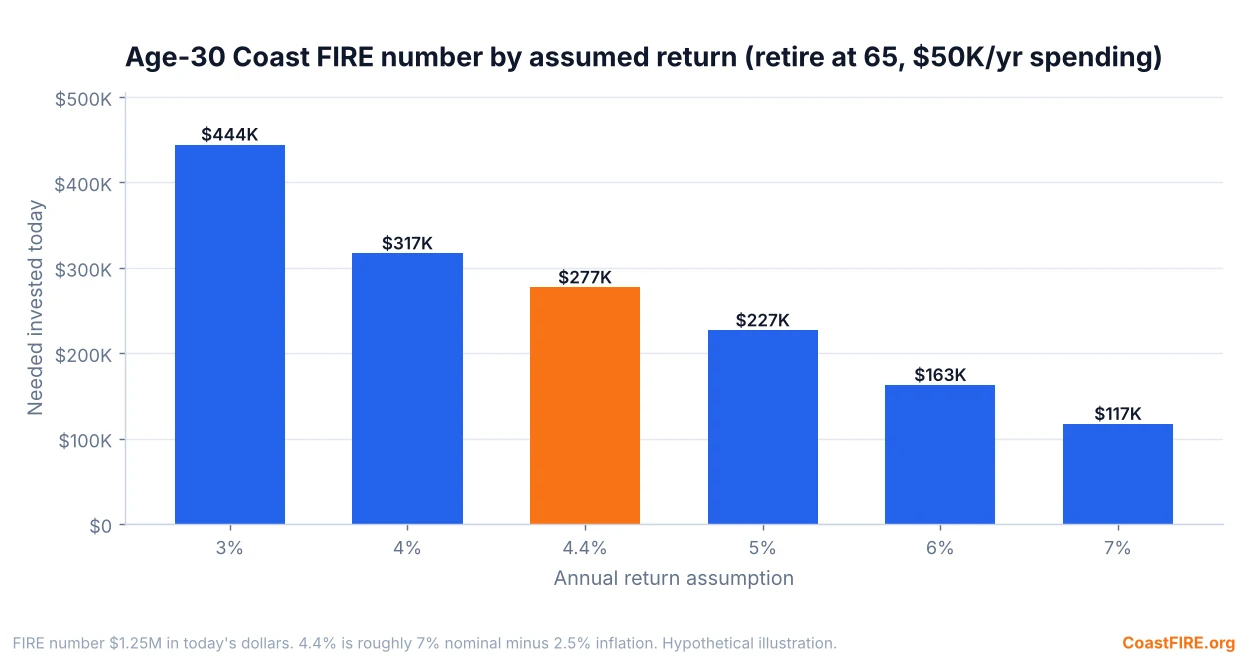
Coast FIRE number at different real returns
The table shows the Coast FIRE number for a $1,250,000 target (today's dollars), retiring at 65. Because the target is in today's dollars, the returns here are real.
| Real return | Age 25 | Age 30 | Age 35 | Age 40 |
|---|---|---|---|---|
| 3.0% | $383,196 | $444,229 | $514,983 | $597,007 |
| 4.0% | $260,361 | $316,769 | $385,398 | $468,896 |
| 4.4% (7% nominal − 2.5% inflation) | $224,137 | $277,852 | $344,439 | $426,985 |
| 5.0% | $177,557 | $226,613 | $289,222 | $369,128 |
| 6.0% | $121,528 | $162,632 | $217,638 | $291,248 |
| 7.0% | $83,475 | $117,079 | $164,209 | $230,311 |
Each row is a different belief about the future. A one-point change in the return moves the age-30 number by tens of thousands of dollars, which is why a single assumed return is a weak basis for a big decision.
How to enter this in the Coast FIRE calculator
- Enter your retirement spending in today's money.
- Enter a real return in the return box (for example 4% to 4.5%), not a nominal one.
- Run it again with a lower value (for example 3%) to see a cautious case.
You can do this right now in the Coast FIRE calculator. If you also want to see what inflation does to a monthly budget, our guide on retiring on $2,000 a month shows the effect in dollars.
What return should you assume?
Nobody knows future returns. A practical approach is to test three cases (low, middle, high) and plan around the cautious one. If your Coast FIRE number is still met under the low case, you have a comfortable margin. If it is only met under the high case, treat your "coasting" as unproven and keep saving a little.
A four-step audit of your own plan
- Check the units of your target. Is your retirement spending in today's dollars or in the dollars of your retirement year? Most people think in today's dollars.
- Check the units of your return. Did you take the return from a fund's marketing page or an index chart? Those are nominal.
- Match them. Either convert the return to a real return, or inflate the target. Never mix.
- Stress-test. Re-run with a return one to two points lower.
How sensitive is the answer to one percentage point?
For the same $1,250,000 target and a 35-year horizon, the age-30 Coast FIRE number changes noticeably with each point of assumed real return:
| Real return | Coast FIRE number (age 30) | Change vs previous row |
|---|---|---|
| 3% | $444,229 | — |
| 4% | $316,769 | −$127,460 |
| 5% | $226,613 | −$90,156 |
| 6% | $162,632 | −$63,981 |
Each extra point of return lowers the number you need, but with diminishing effect, and you cannot control the return. What you can control is the margin: if you plan with 4% and the future delivers 3%, you will be short by roughly $127,460 in this example.
What if my calculator only has one return box?
That is the case for most online calculators, including ours. The simple rule is: if you type today's-dollar spending, type a real return. If you want to use a nominal return like 7%, inflate your spending first. For example, $50,000 of spending in 35 years at 2.5% inflation is $118,660 a year, which gives a FIRE number of $2,966,506 in future dollars.